Blog
The sound of liberation heard again after 80 years
- GSEP Music
- GSA(GAUDIO Spatial Audio)
- Separation
- Spatial Audio
- Generative AI
- FALL-E
- Tech
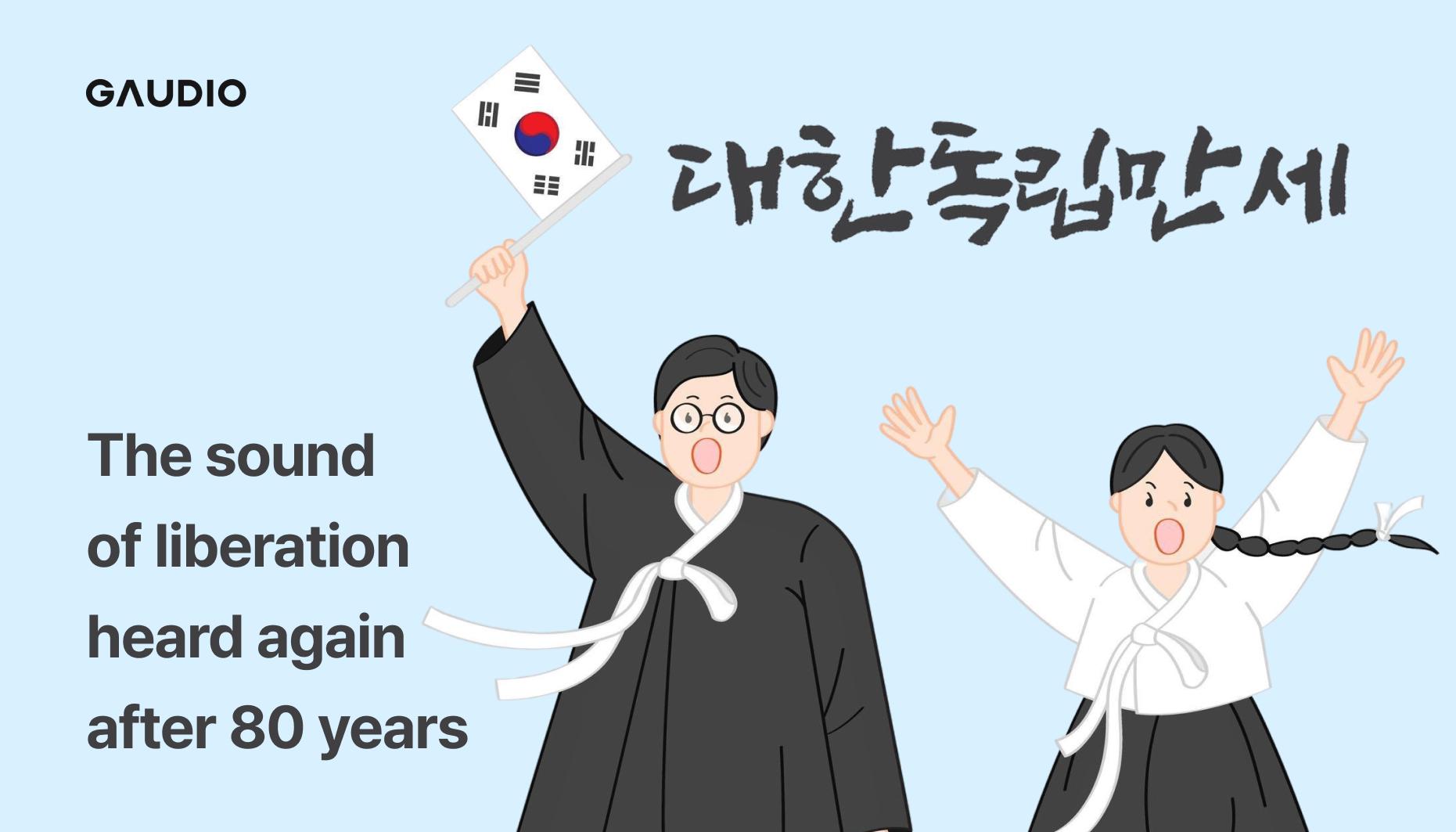
Binggrae’s [First Sound of Liberation] campaign brings back the cry of Daehan Doknip Manse (Long Live Korean Independence) with Korean AI technology.
Just six days after its release, Binggrae’s First Sound of Liberation campaign surpassed 4 million views, quickly becoming a topic of conversation. Marking the 80th anniversary of Korea’s Liberation Day, the campaign reimagined the sound of liberation that had never been heard before—made possible through cutting-edge AI audio technology. Behind this recreation stood the technology of Gaudio Lab, a Korean Audio AI company. By combining historical research with advanced audio AI, they revived the cries of liberation that history had recorded only in text, but never in sound.
So, how was this unheard sound, lost for 80 years, finally brought back to life?
Recreating the Cry of Independence
On August 15, 1945, Japan announced its surrender. The next day, jubilant crowds filled the streets shouting “Daehan Doknip Manse”—a cry of independence that symbolized the nation’s freedom. Countless written records remain from that time, but no sound recordings exist.
This absence became the starting point for Binggrae and Innocean, who collaborated with Gaudio Lab to recreate what had once been impossible: the lost sound of Korea’s liberation. By restoring the voices of that day, the project not only gave sound to history but also honored the sacrifices of independence activists. It was more than a campaign—it was a meaningful attempt to revive the fading memory of liberation through hearing.
Gaudio Lab's AI Source Separation, GSEP
At the heart of the project was AI source separation. This technology extracts individual sounds from complex audio signals. Gaudio Lab’s AI source separation technology, GSEP, was used to remove noise from recorded audio, delivering the core sounds clearly and cleanly.
Testimonies from independence activists’ descendants, historical references, and verified archival materials were collected. Much like preparing ingredients for a fine meal, GSEP processed these “sound ingredients” into clean, high-quality audio—the foundation for recreating history.
Bringing History to Life with Generative AI
To generate sounds that had never existed, Gaudio Lab’s generative AI technology came into play. Binggrae and Innocean carefully curated factual details—ranging from historical documents to environmental conditions such as temperature and humidity on that day. Based on these cues, they reconstructed everything—the sound of clothes brushing, footsteps for different kinds of shoes, the tram running on the street, and flags waving in the wind. Expert historians validated each step of the process, ensuring historical accuracy.
Generative AI then added human dimensions—age, gender, emotion—to recreate the voices of crowds shouting “manse.” Layered with the acoustic atmosphere of Seoul Station Plaza, the voices came alive with an authentic sense of immersion. Finally, audio upscaling technology was applied to transform lower-quality sounds into richer, more impactful experiences.
Immersion Through Spatial Audio
Spatial audio was the finishing touch, giving listeners the sensation of truly standing amidst history. Gaudio Lab’s spatial audio technology, recognized as an international standard, applies binaural rendering to deliver a fully immersive 360-degree experience.
The creak of iron gates opening, the rush of crowds spilling onto the streets, the metallic clang of sheet iron, the fluttering of Taegeukgi (Flag of South Korea)—each was placed in a 3D soundscape. From the footsteps outside Seodaemun Prison to the swelling cheers at Seoul Station Plaza, the recreated scenes resonated with a realism that text alone could never convey.
More than sound—Capturing emotion
Recreating the “Sound of Liberation” was never just about reproducing audio. It was about conveying the emotions of that moment—the heat in the air, the tears of joy, the overwhelming surge of voices rising together. Each sound was carefully refined and layered with AI technology to carry not just noise, but history, memory, and feeling.
For Gaudio Lab, it was a profound honor to take part in this meaningful project as a Korean Audio AI company. Bringing the first-ever “Sound of Liberation” to life and passing it down as a historical record for future generations was both a responsibility and a privilege.
And we are not stopping here. Gaudio Lab will continue striving to delivernew experiences through sound—bridging technology, history, and emotion.
Our audio technologies support various devices and platforms.